
Physical First Aid and Mental Health First Aid: The Skill Gap No One Talks About

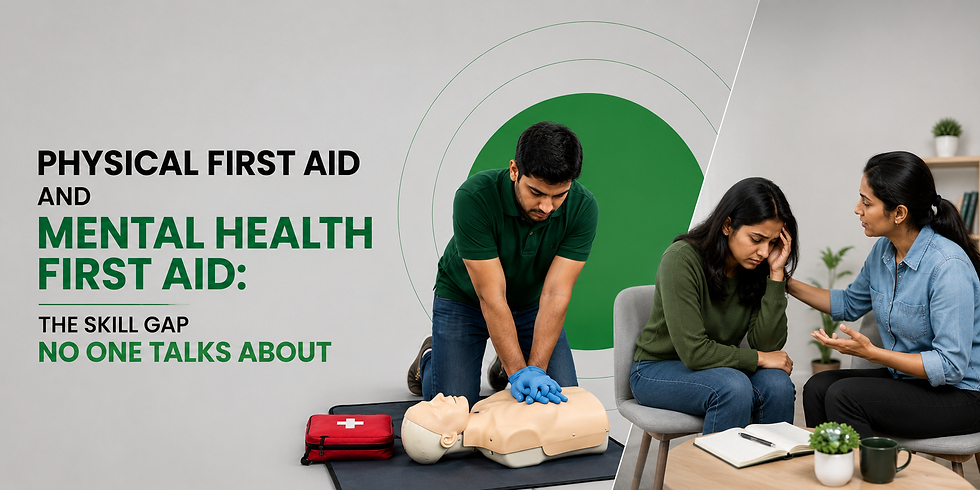
Walk into any office, school, or public building, and somewhere on its wall you'll find a physical first aid kit. Fire drills happen periodically in schools and colleges. Some people at your workplace know CPR. Decades of effort have gone into making sure people know how to respond when someone is dealing with a physical injury. Now, picture a different kind of emergency.
A colleague who used to pitch three ideas in every meeting has gone quiet for weeks, and nobody's said anything. A student who never missed a single deadline stops showing up to class. A friend keeps saying "I'm just tired" until one day they admit they haven't slept properly in a month, can't remember the last real meal they ate, and aren't sure what the point of any of it is anymore. No wound to point at. No kit on the wall for this one. What you get instead, usually, is silence. Not because the people around them don't care. They simply don't know what to do with what they're seeing, which is exactly where mental health first aid becomes critical.
We've spent generations normalising the idea that a sprained ankle or a kitchen burn deserves a trained response. The idea that an invisible injury deserves the same? Barely registers. So, we end up with a strange contradiction: plenty of willing people, almost none of them equipped, standing next to someone who's quietly falling apart.
We Didn't Always Know Physical First Aid Either
For a long stretch of history, anything medical was considered the doctor's job and nobody else's. That changed slowly, through deliberate public education, until CPR and basic wound care became things millions of ordinary people just... know. Nobody mistakes a person doing chest compressions for a paramedic. Their job was never to replace the ambulance — just to keep things from getting worse until it arrived. That one shift turned a specialist skill into a life skill.
Mental health first aid is sitting at roughly that same fork in the road right now. Nobody's really arguing anymore about whether it matters. That debate is basically over. What's left is a much harder question: are we actually giving people the tools to do something useful when someone nearby is struggling?
Awareness Doesn't Automatically Become Action
Mental health gets talked about constantly now. Companies run wellbeing webinars. Colleges hold awareness weeks. Instagram is full of infographics about burnout and anxiety. Despite this constant chatter, the problem is escalating. The McKinsey Health Institute’s 2023 survey reported that 59% of the Indian workforce is currently experiencing burnout symptoms — the highest rate globally. We are more aware than ever, yet we are still freezing when the crisis is standing right in front of us.
Most of us know that moment — someone shares something raw and unguarded, and the brain just short-circuits. Do you ask more questions? Stay quiet? Offer advice nobody asked for? Is it dangerous to even say the word "suicide" out loud, in case that somehow plants the idea? What if you say something clumsy and make it worse?
None of these doubts are unreasonable. But doubt, left unaddressed, tends to curdle into doing nothing at all.
Here's the part people miss: it's the not knowing that stops them, not a lack of caring. Nobody is born knowing how to do chest compressions either. It's taught, practiced, and eventually it becomes instinct. There's no reason supporting someone through a mental health crisis should be any different.
Mental Health Emergencies Rarely Look Like Emergencies
A big part of why this gets missed is that psychological distress rarely announces itself:
Someone with depression can still clock in every single day
A student wrestling with severe anxiety might sit through every lecture without missing one
A manager quietly burning out often just seems a bit short-tempered, a bit checked out — nothing you'd flag in a performance review
But the numbers tell a different story. Mental Health First Aid India’s 2026 research on Working Hours, Productivity, and Wellbeing reveals that South Asia clocks the longest average workweek globally at 49 hours. We treat this as a badge of honor, but the data shows it's a breaking point. Beyond those 49 hours, total output actually drops. In fact, workers dealing with fatigue from prolonged hours lose an average of 4.1 productive hours every single week just to impaired focus. It's not a 'busy season' — it is a systemic drain that costs both the person and the organization
Mental health struggles tend to build slowly in increments, so small enough that nobody around the person clocks the shift until it's already serious. By the time it's obvious to everyone in the room, the person may have already spent months handling it entirely on their own.
That's the window where early support actually changes outcomes, not because a friend turns into a therapist overnight, but because somebody notices, says something, and nudges the person toward help before things spiral further.
The First Person Someone Turns To Usually Isn't a Professional
Say "mental healthcare" and most people picture a therapist's office, a psychiatrist, a counsellor with a clipboard. The first person someone tells is almost always someone they already trust. A friend. A sibling. A coworker they grab coffee with. A teacher who's been kind to them. A manager. Sometimes just a neighbour who happened to ask "you good?" at the right moment.
The problem is none of these people signed up for this. They care, deeply, but they're working off gut instinct, secondhand advice, or whatever they half-remember from a podcast. Sometimes that instinct lands well. Sometimes it flattens the moment entirely without meaning to.
"Everyone goes through this." "Just stay positive." "You'll get over it." Every one of these is said with good intentions and lands like a door closing. For someone already struggling, lines like that can confirm the very thing they feared most: that nobody actually gets it. Caring isn't the missing ingredient here. Skill is.
Mental Health First Aid - A Skill, Not a Substitute for Expert Care
Mental health first aid training addresses exactly this gap. built on a fairly unglamorous premise: ordinary, untrained people can learn to spot the early signs of a mental health problem, offer real support in the moment, and point someone toward professional help.
What this kind of training isn't gets misunderstood constantly.
It does not:
Turn a manager into a counsellor
Teach a teacher to diagnose anxiety disorders
Qualify anyone to treat anything after a single session
And the shift is measurable. Mental Health First Aid impact data shows that trained workplace participants exhibit an 81.2% improvement in help-seeking attitudes. What this training actually does is prepare people for moments they're already walking into.
Recognising the signs
Opening a conversation without making it weird
Listening without immediately trying to fix it
Knowing what to do, and what not to do, if someone is in genuine crisis
Pointing someone toward professional help while still respecting their boundaries
It's the same philosophy as a first aid kit, just applied to a different kind of injury. Not a replacement for expert care. A bridge to it.
Why This Matters More Than Ever
Work looks different now. Study looks different. The World Health Organization estimates that 12 billion workdays are lost every year globally to depression and anxiety. Professional mental health support hasn't kept pace with any of this, access is patchy at best, and even where it exists, stigma and fear of judgment keep people from walking through the door. Which leaves an obvious gap. And the people standing in it are us, not as clinicians, not as people with all the answers, but as the first line someone runs into before they ever reach a professional.
A workplace, a campus, a family dinner table, a building full of neighbours who barely speak — these are the spaces where someone first decides whether asking for help feels safe or feels stupid. Communities that know how to notice and respond tend to get that decision right more often.
Because not every emergency comes with blood or a broken bone. Sometimes it starts with a conversation somebody has been waiting far too long for someone to start.
Sources:
1. Working Hours, Productivity, and Wellbeing (Dwivedi et al., 2026)
LMHFA India Research & Blog (Note: This official page contains the specific data on the 49-hour workweek and the 4.1 lost productive hours).
2. McKinsey Health Institute Survey on Employee Well-being (2023)
3. MHFA India Impact Data (2018–2024)
MHFA India Impact Statistics (The 81.2% improvement stat is detailed toward the end of this paper).
4. WHO and ILO Policy Brief and Guidelines on Mental Health at Work
Author Name: Erinda Shah, Psychotherapist, Managing Director, MHFA India


Comments